
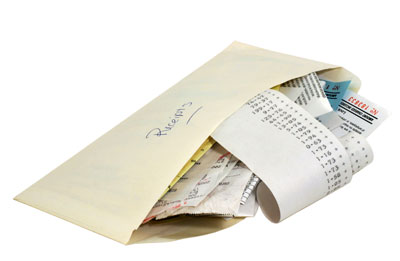
 Are you saving your home staging business receipts?
When you decide to go into business for yourself as a professional home stager, you have no choice but to start thinking about business expenses.
One of the advantages of operating your own business is that you get to write off many of your expenses against your income.
This has tax advantages.
If you don’t have a bookkeeping or financial background (which I don’t), it’s a good idea to start building a relationship with a good accountant.
Home Staging Business Receipts Will Save You Money Come Tax Time
If you haven’t started your home staging business yet, but you’re planning to and you’re in the process of taking courses, or researching the business, start keeping those receipts because they’ll come in handy later.
Whether you started your business in January, last month, or today it’s not too late to start thinking ahead about your next tax return.
For that matter, even if you’ve been in business for years it’s never too late to pick yourself up by the bootstraps and focus on doing something better for the next year!
I’m not an accountant, so this is no substitute for official tax advice. That said, as a long time entrepreneur I can say that it’s important to hang on to every single receipt you get your hands on that could possibly be considered a business expense.
This will allow you to lower your reported income at the end of the year, and therefore lower the taxes you owe.
Home Staging Business Expenses May Surprise You
Possible business expenses for you as a home stager might be any of the following:
- Home staging courses and resources you purchase from the Staging Diva Store
- Subscriptions to magazines and newspapers
- Décor, business or any other type of reference books
- Cell phone and Internet bills
- Vehicle expenses (Keep a notepad in your car to track mileage for staging projects.)
- Insurance
- A portion of your mortgage (if you have a home office)
- A percentage of your utilities like heating and electricity
- A percentage of your cable bill (you need to watch HGTV right?)
- Office supplies
- Postage and courier bills
- Travel expenses
- Staging props like vases, decorative soaps, plates and glassware
- Restaurant bills
- Cleaning bills
- Business gifts or gift certificates
- Fresh flowers (needed for staging or portfolio photography)
- Computer equipment and software
- Camera
- Business coaching
Of course you have to know which of these items are legitimate business expenses for tax laws that apply to you. That’s why it’s important that you find an accountant who specializes in small business, and the sooner the better.
When in doubt about whether or not something is a legitimate expense, err on the side of caution and hang on to the receipt. Let your accountant determine if it can be used or not.


Dear Debra, my first year in business I used a simple Excel spreadsheet. But then I started using QuickBooks Simple Edition in my second year, and then the more sophisticated Quickbooks regular addition. I find using something like QuickBooks is very useful because you can easily run a profit and loss statement whenever you like, you can record checks written so that you always know your bank balance, and most importantly when you reconcile your credit card statements, I always find expenses I forgot to record! I think the latter has been the most valuable part of Quickbooks for me.
Thanks Donna, those are great tips for other readers. I used Quicken for years, which I found really easy.
About 3 or 4 years ago, I got tired of doing that and now I just give the big box of sorted receipts to my accountant at the end of the year and they take care of it. I found it didn’t add much to my costs.
However, I do put almost every business expense onto a credit card that pays me air miles. Each month I go thru the statement, attach the receipts and identify each expense on the statement as to what category it belongs to.
The other thing I do is keep all my money going thru a business bank account, it’s not mixed with personal.
I have somewhat of a bookkeeping background, and, luckily, I had a relationship with a great CPA when I started Show Smart Home Staging & Design in the Washington DC Metro area. She is worth her weight. That said, probably the best first step I took besides taking the Staging Diva Business Course was to open a bank account with attendant debit/Visa card dedicated exclusively to my business. I never buy anything, pay anybody, deposit any payments anywhere else, so everything is in one place at year end, ready.
Thanks Patricia. Totally agree with you on importance of keeping business and personal banking separate.
Thank you, Debra! That overview was sooo helpful! As usual, Debra Gould does it again.
Thank you, Debra. Let me add, I too have a big box where all the paper receipts go. Every $.96 one from Goodwill even. Should I get audited, it won’t be pretty, but all the backup exists. I try to remember to change boxes at the end of each year and mark the prior one.
I do that too!
Any recommendations for basic accounting software for home stagers .
You don’t need anything very complicated because home staging is a very simple business to run if you’re following the business model I teach in Staging Diva. If you’re also in the furniture rental business (not something I recommend), then that’s a whole other matter.
To be honest, I just hand my box of organized receipts to my accountant at the end of the year and he takes it from there. He uses QuickBooks for all his clients.
I don’t even use any accounting software, though I used Quicken about 20 years ago.
Instead of keeping a notepad to keep track of miles, I use an app on my iphone called MileIQ. The first 40 drives each month are free or you can get unlimited mile tracking for $60/year. It automatically keeps track of the miles and then I go back and categorize them as business or personal. I then take the monthly report and use it for business taxes. This app makes my life so much easier!
That’s such a great way to do it Kasia! Thanks for sharing this app with us!
I also use MIle IQ to track my business miles. It’s far more accurate than a note pad in the car, so I know I’ve made my money back in additional saved income.
That’s a great tip Deb, thanks for sharing!
I love making things beautiful, the quizes were great and the whole reading was very helpful thanks.
I’m so glad I could help you Christina! I think you’ll love this page too, I answer the top 25 questions most home stagers ask me.