
Today’s photography tip for home stagers is probably the most important one of all, especially if you’re currently developing your home staging portfolio. As a home stager this advice is probably pure common sense to you, but I will assume nothing and share anyway. Sometimes it’s the most obvious thing we overlook.
Be obsessive in your attention to detail.
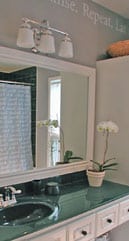 As a stager, you’re naturally focused on the details, but each photo that’s going in your portfolio must be perfect. Don’t let any visual distractions clutter your image. Straighten art and lampshades and turn off the television.
If you’ve staged a bathroom beautifully but the client won’t let you store their toothbrushes off the counter, remove them for your shot and then put them back.
If you recommend all shoes and coats be removed from the entry way, but the client won’t have it, get those items stashed out of the way before you take your picture and then replace them.
Clients don’t always follow our advice to remove their “tchotchkes”. But when it’s time for your after shots, take those “priceless collections” off of the kitchen counters or cupboards and the fireplace mantel before you shoot.
In the bathroom, don’t take a picture of the open toilet and in the bedroom make sure dust ruffle meets, and runs parallel with, the floor. These unattended to small details will reflect poorly on your staging abilities so don’t overlook them.
To catch up on the other two posts in this series, here’s a link to the first (about thinking before you take your photo) and the second (where I shared some digital camera basics).
On Wednesday, in the fourth and final installment of this series, I’ll share the importance of telling a strong staging story with your shots and how to do that.
Please add your thoughts and your own photography tips by clicking the comments link below. I would love it if you would add to this conversation!

Debra Gould, The Staging Diva®
President, Six Elements Home Staging
Home Staging expert Debra Gould also known as The Staging Diva knows how to make money as a home stager and is determined to inspire and teach others to do the same. There are over 7000 Staging Diva students around the world. Learn more about the Staging Diva Home Staging Business Training Program.

Great advice, thanks Debra
I’ve a few tips…..
if you have floppy shams or pillowcases I keep the protective corners from any art or mirrors that I buy and place them inside shams to give a sharp definition to the shams. Don’t forget to remove them after taking the picture!
I always have painters tape in my tool box as it can temporarily hold up phone or lamp wires under tables tops, desks etc.
When used in a double sided way it can keep pillowcases from falling open in your shots and I’ve even used it to tape down a comforter that kept creasing no matter how much I ironed it!
I have been known to get someone laying on the floor pulling the comforter tight whilst I take the shot from the other side….obsessed? Maybe but there is nothing worse than getting home after the job and finding that the shots do not reflect all the hard work you have put into the project.
We are in the process of revamping our website and I cannot believe how many shots we are rejecting due to silly mistakes during the shoot so thanks for reminding me how important it is.
Annie, I love the details you’ve shared. They will be most helpful to others!
I’ve always thought that home staging is the perfect occupation for perfectionists bordering on the obsessive compulsive 🙂
Everything you’ve described as the lengths you go to for the perfect shot are TOTALLY appropriate. But not everyone would have the patience to go to these lengths.
I worked in advertising for many years before turning to home staging, and I can assure you that professional photo stylists do fret about these exact details, and they are what truly make winning shots stand out.
Bravo Annie!
I have taken shots of my home with my cell phone. I am truly obsessed with light so I vary the lighting in all my shots. The pictures come out great.
Fantastic Shelly, thanks for sharing your experiences! Cell phone cameras have come so far even in the last year!
All great tips…thank you.
I also want to share that you should try to remember to take your shots from the same position so it’s obvious for the viewer to see the changes you made. It’s easy to forget where I stood from the first appointment so I often take multiple shots at different corners of the room, some come out better than others due to lighting etc. so I capture everything and then I can choose which pictures/angles to use. And if all else fails – CROP IT OUT!
I agree Jodi, that’s a great tip. Adding to that idea…. I try and sort through my pile of before shots before I go back to shoot the afters. Then I figure out which before’s I like best and remind myself where I was standing so that I can make sure to stand in the same spot for the after.
If you have a laptop that you can bring with you to the client, you can even pull up your before shots on screen while you’re there to shoot the after. Added benefit of having the computer with you is that if you run out of storage in your camera, you can download your images to your computer and then keep shooting.
Thanks for writing in with your ideas! Everyone who adds to this discussion helps benefit others and with my readers’ help I can turn Home Staging Business Report into an even more valuable reference and resource!
Best,
Debra
Just wondering when your new show will air in the U.S.A.
Hi Rosemary, not sure if and when the HGTV show will air in the US. But I did get a copy of it and will be putting an excerpt on the media page of stagingdiva.com very soon. Will announce it when it’s available.
Thanks for your interest!
Debra
Another tip to make sure you have a great pair of before and afters, is make sure they are both, either landscape or portrait. A portfolio looks really yuck when they are all mixed. Now I tend to stick to landscape shots for consistancy.
This may seem obvious, but I learnt the hard way very recently, always check your camera is on the setting for taking the best quality photo’s. There’s no place in a portfolio for fuzzy after shots.
Hayley, those are great tips too, thanks for adding to the knowledge base here which I know will help everyone!
Debra
Great ideas Annie,
I also use use Picasa- free software editing. I can lighten, crop, airbrush, caption and lots of other interesting things.
I am also showcasing a professional photographer’s shots of my work on my site- as an upgrade (and very appropriate referral fees- thanks Debra!). He will have a separate page so his skills do not make mine- whihc are very good- seem poor. His ‘pro page’ will reflect well on my community connections. He also shares his ‘secrets’ ! His shots of my work my portfolio- actual not virtual- (ie the one I bring to trade shows and consults.. not the online version) should become increasingly impressive.
Hi Debra-
Another post idea- free floorplan software. I know it’s a bit too involved for typical staging work- but appropriate in this instance. I’m doing a 6 bedroom beach house- “for real” staging… It’s going to be rented a year before sale. I need to communnicate with the owners a bit- it will be about $20,000 – $25,000 worth of furnishings.
I’m leaning toward Sweet home 3D.
Have a great day!
Daryl
Daryl thanks for the suggestion.